
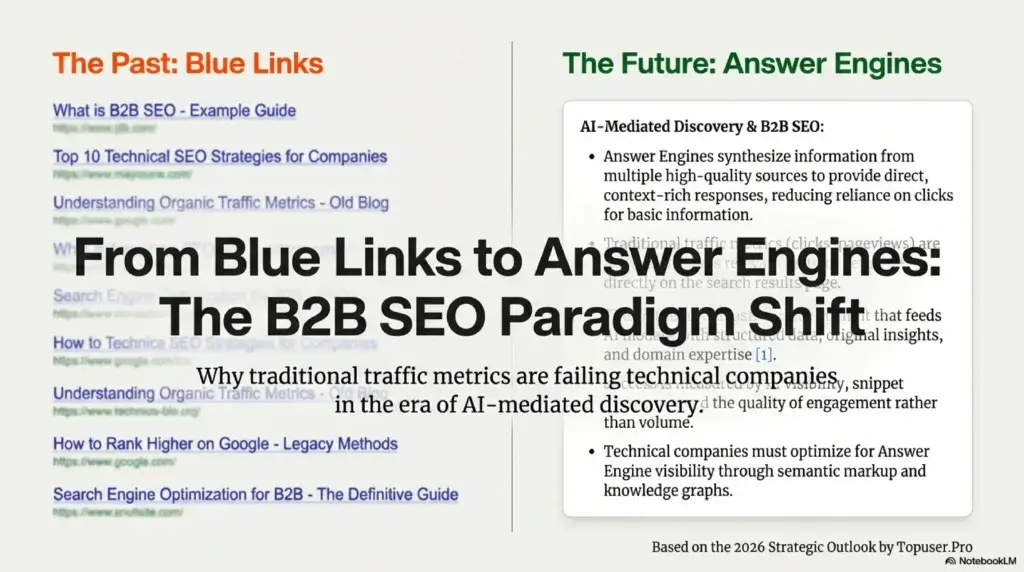
The most common strategic mistake in technical SEO for the B2B sector is prioritizing traffic volume over lead quality and purchase intent. This misalignment often stems from the outdated mindset that more traffic equals more revenue. Therefore, one of the significant mistakes observed among B2B technical SEO companies is a persistent, systemic failure to move beyond a traffic-based model.
This failure manifests as a reliance on informational content that lacks intent, a burgeoning accumulation of technical debt, and a catastrophic misalignment between organic search strategies and revenue operations.
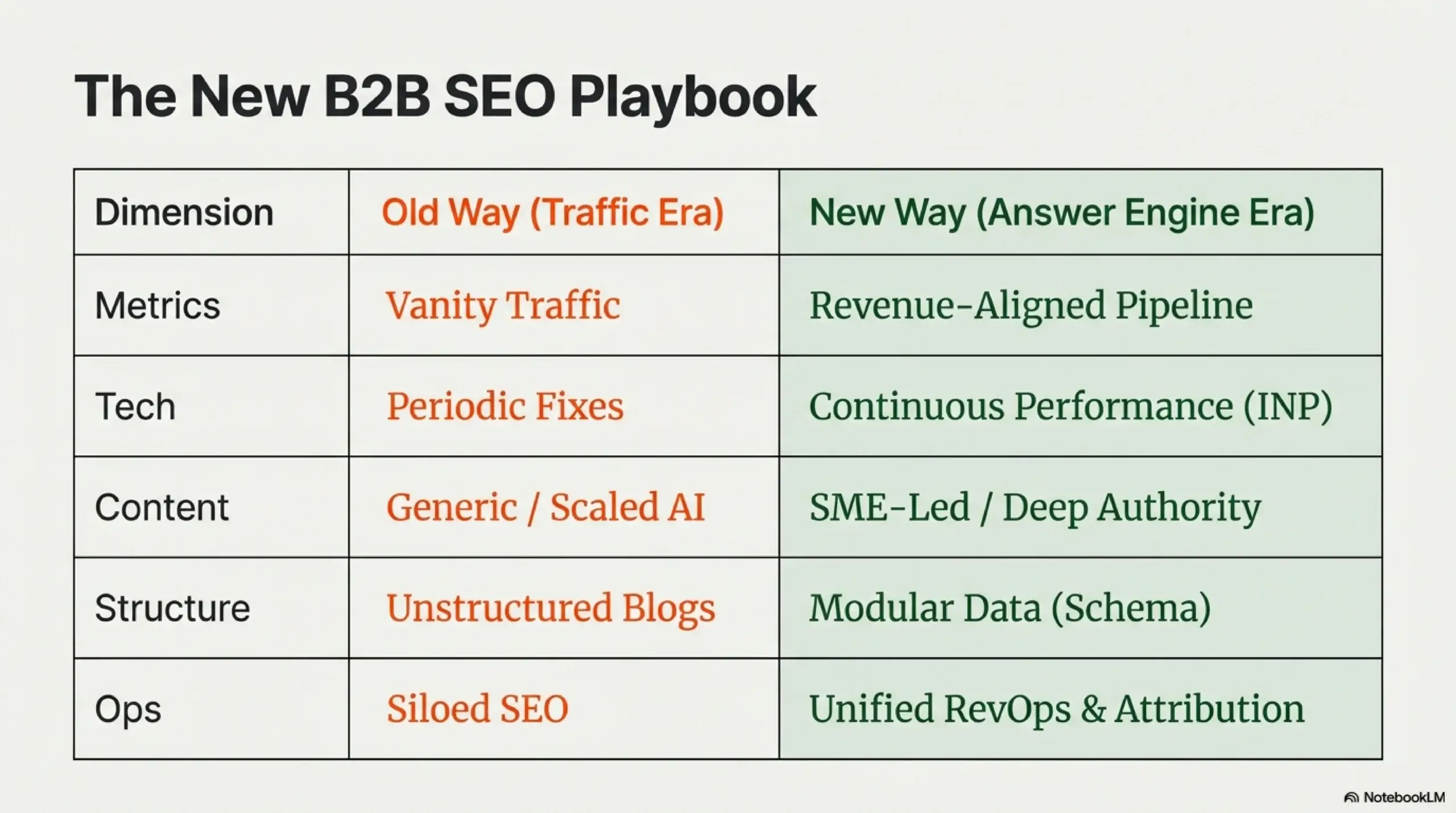
The transition from the “blue link” era of search to the “answer engine” era has exposed deep-seated vulnerabilities in how technical companies approach their digital footprint.
For years, the industry standard for success was predicated on the acquisition of top-of-funnel (TOFU) traffic through broad educational topics. However, in an age where Google’s Search Generative Experience (SGE) and AI Overviews (AIO) satisfy these informational queries directly on the search engine results page (SERP), the traditional informational blog has entered a terminal decline.
The companies that continue to prioritize vanity metrics, such as total organic sessions, while ignoring the fundamental shift toward intent-aligned, authoritative, and technically resilient discovery, are experiencing a measurable atrophy in their sales pipelines.
SEO Shift in Intent.
In technical niches, however, the buyer journey is significantly more complex than in consumer markets, characterized by multi-stakeholder decision-making, high skepticism, and extended research phases. When a company focuses exclusively on ranking for high-volume, broad informational terms, it inadvertently creates a traffic without intent scenario.
This disconnect leads to a situation where the marketing department celebrates growth while the sales team learns to ignore SEO leads because they lack qualified intent.
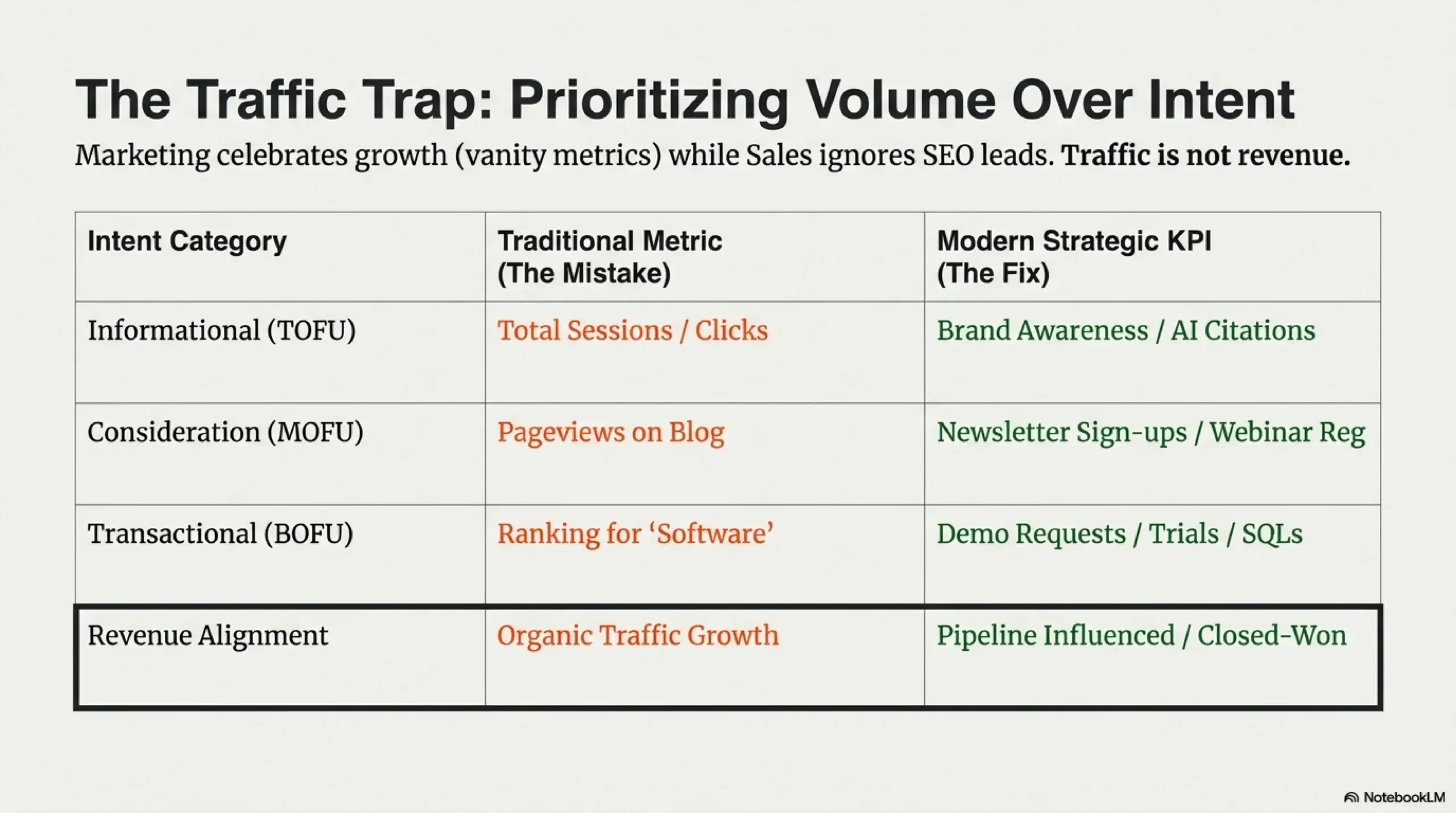
| Intent Category | Traditional Metric (Mistake) | Modern Strategic KPI (Correct) |
|---|---|---|
| Informational (TOFU) | Total Sessions / Clicks | Brand Awareness / AI Citations |
| Consideration (MOFU) | Pageviews on Blog | Newsletter Sign-ups / Webinar Reg |
| Transactional (BOFU) | Ranking for “Software” | Demo Requests / Trials / SQLs |
| Revenue Alignment | Organic Traffic Growth | Pipeline Influenced / Closed-Won |
The economic cost of this mistake is substantial.
By focusing on vanity metrics, B2B firms suffer from an inflated cost per acquisition (CAC) and a diminished customer lifetime value (LTV). A nuanced understanding of the buyer’s journey reveals that technical decision-makers are not seeking surface-level education. They are searching for solutions to specific operational friction points. When content fails to address these pain-point keywords, focusing instead on feature lists, the content fails to resonate with the user’s actual problems, reducing both search visibility and conversion rates.
The Technological Disruption of the Zero-Click SERP
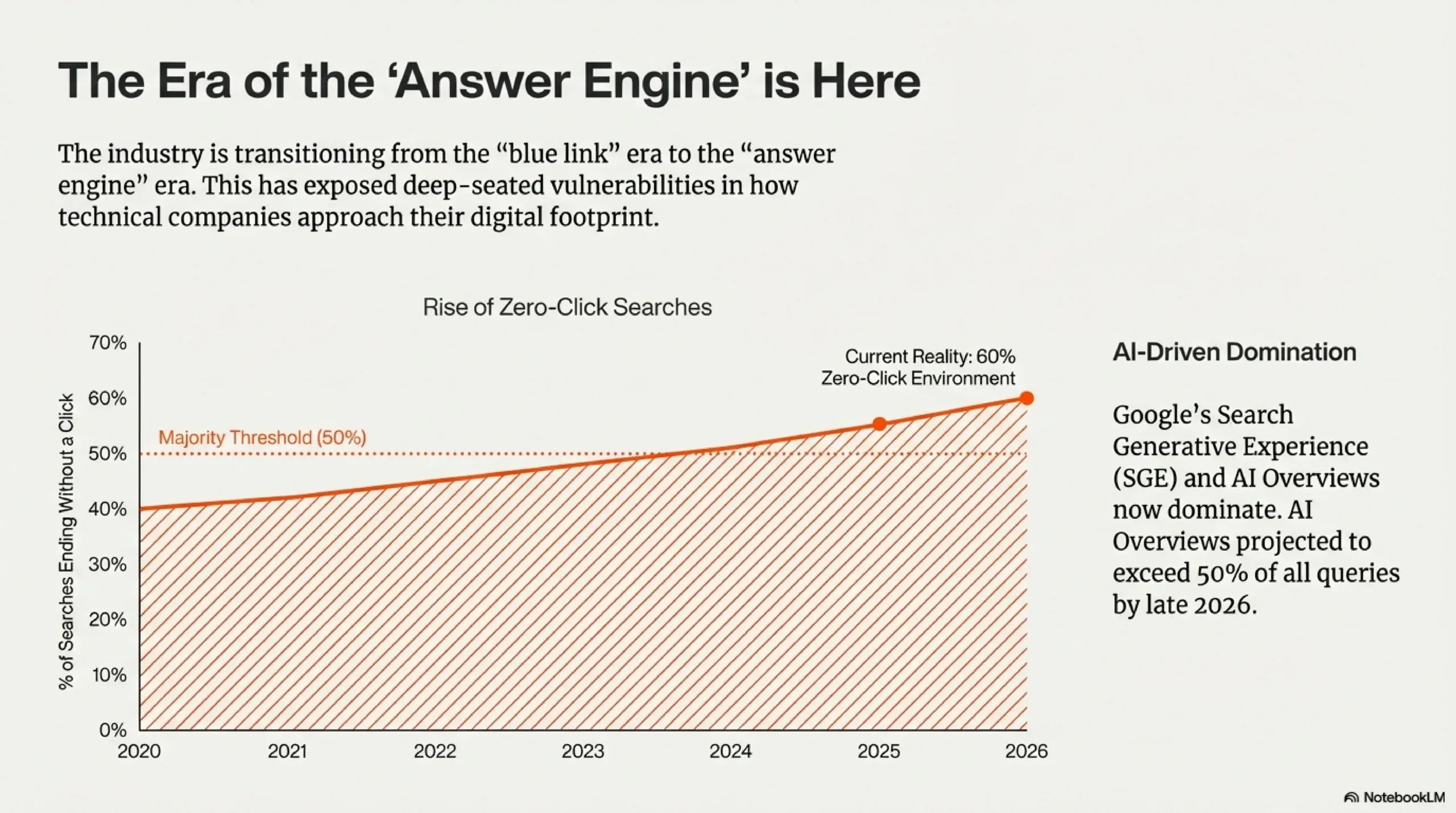
The rise of AI-powered search features has fundamentally altered the economics of organic traffic. Google’s AI Overviews now appear for approximately 15% to 20% of search queries, with projections suggesting this figure will exceed 50% by late 2026. This development facilitates a “zero-click” environment where nearly 60% of searches end without a visit to a website because the user’s question is answered directly on the SERP.
B2B technical companies are making a critical error by not adapting their content architecture to this reality. The traditional informational blog is essentially dead in its current form.
The mistake is two-fold: companies are still producing the kind of “fluff” content that AI can easily synthesize, and they are failing to structure their high-value insights so that AI systems can cite them.
The decline in click-through rates (CTR) on informational queries is estimated at 15% to 25% where AI Overviews appear. For B2B firms, this necessitates a pivot from pure traffic generation to establishing thought leadership that AI systems recognize and reference. Brand visibility is no longer defined solely by a blue link; it is now defined by citation frequency and message penetration within AI-generated summaries.
| Metric | Pre-AI Search Impact | AI-Mediated Search Impact |
| Click-Through Rate (CTR) | Primary Driver of Value | Significant Decline 15 to 25 percent |
| Zero-Click Searches | Minority of Queries | Majority approx. 60 percent |
| Brand Citations | Indirect SEO Value | Primary Visibility Signal |
| Informational Queries | High Value for Traffic | High Risk of Traffic Cannibalization |
Answer Engine Optimization and the Structural Citation Gap
As the search landscape shifts toward Answer Engine Optimization (AEO), many B2B technical companies are failing to implement the structural requirements necessary for AI comprehension. AI systems, including large language models (LLMs) and search assistants, evaluate content based on its ability to provide clear, actionable guidance that reduces user uncertainty.
A significant mistake in this area is the production of dense, unstructured content that is difficult for AI to parse and extract. AI answer engines prefer content written in a conversational, question-and-answer format. Companies that neglect to use clear heading hierarchies (H2 and H3 tags) that mirror actual user questions are effectively becoming invisible to these systems.
Furthermore, the implementation of structured data (Schema markup) has evolved from an enhancement to a foundational requirement. Specifically, the omission of Article, FAQ, How-to, and Organization schemas prevents AI overviews from accurately interpreting and citing content. This “citation gap” represents a major lost opportunity; when a brand is mentioned in an AI-generated answer, it builds a level of trust and authority that traditional search results cannot match.
To bridge this gap, technical firms must adopt a “modular” content strategy. Instead of long, monolithic guides that attempt to cover every aspect of a topic, successful organizations are creating structured clusters of interconnected content that demonstrate depth and subject-matter authority.
Technical Debt and the Performance Crisis
While content strategy shifts are highly visible, the underlying technical foundations of many B2B websites are deteriorating, leading to what is described as “digital decay”. Technical SEO is often treated as a one-time project during a website redesign, rather than a continuous operational requirement. This neglect results in a accumulation of “performance debt” that directly impacts search rankings and conversion rates.
The Core Web Vitals and INP Transition
A major technical error is the failure to meet modern performance standards, specifically Google’s Core Web Vitals. In March 2024, Interaction to Next Paint (INP) replaced First Input Delay (FID) as a core metric, yet many B2B sites have not optimized for this shift. INP measures the latency of all user interactions on a page, and it is frequently degraded by heavy third-party scripts—such as chat tools, tracking pixels, and tag managers that block the main thread.
| Core Web Vital Metric | Target Threshold | Primary B2B Technical Failure |
| Largest Contentful Paint (LCP) | < 2.5s | Unoptimized hero videos / images |
| Interaction to Next Paint (INP) | < 200ms | Excessive 3rd-party JavaScript |
| Cumulative Layout Shift (CLS) | < 0.1 | Late-loading fonts and ads |
Research indicates that nearly half of the technical web underperforms on these real-user experience signals. For B2B technical firms, where the website often serves as the primary conversion engine, slow load times and sluggish interactivity are not just IT problems; they are revenue problems. Improving loading speed by just 0.1 seconds has been shown to boost conversion rates by reducing user abandonment.1
JavaScript Rendering and Indexing Barriers
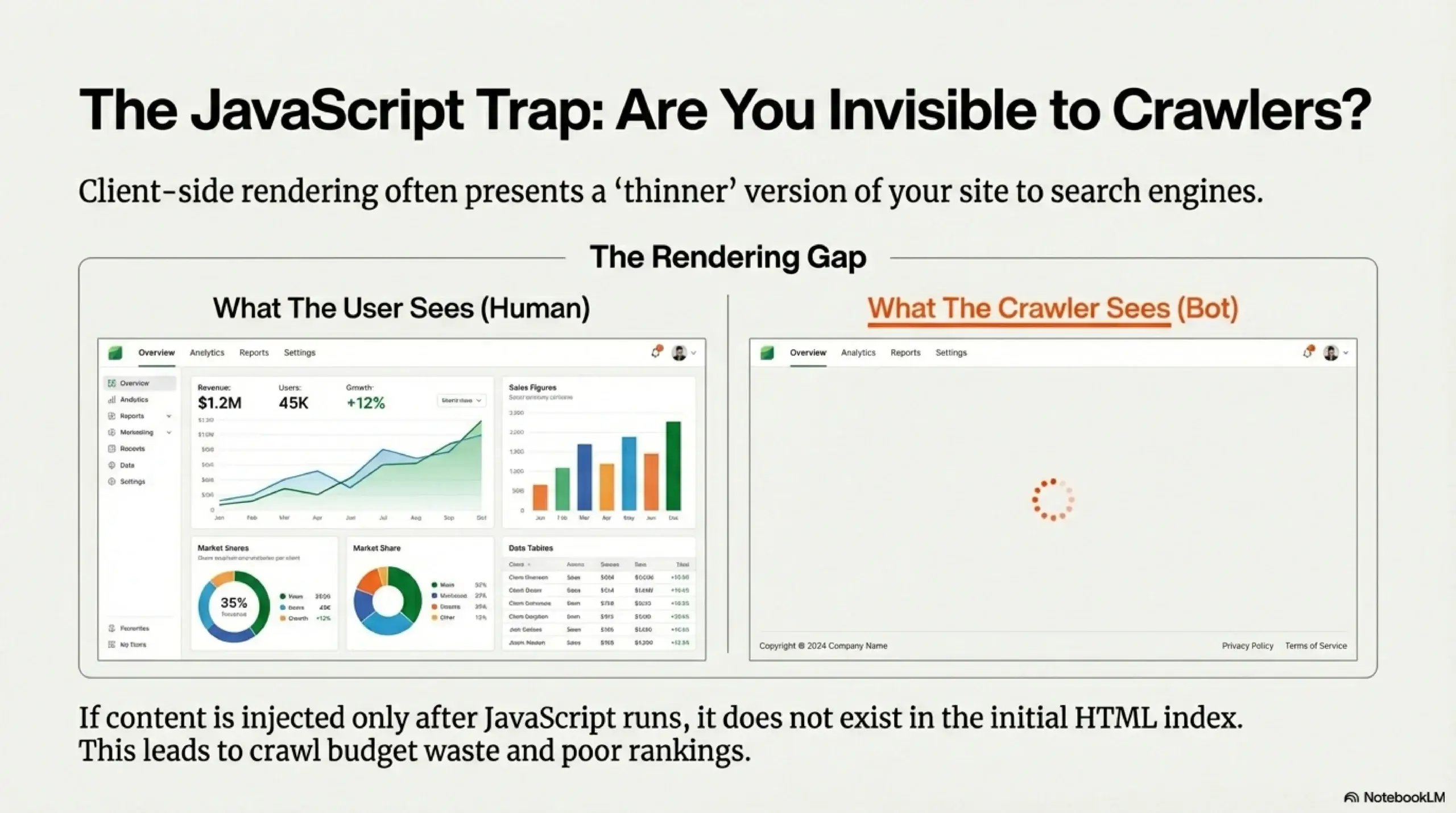
The increased use of complex JavaScript frameworks in B2B SaaS websites has created significant barriers to indexing. A common mistake is relying on client-side rendering without ensuring that search crawlers can see the “full” version of the page. If key content or critical internal links are only injected after JavaScript runs, crawlers may see a “thinner” version of the site than human users do, leading to poor rankings.
Moreover, the mismanagement of “crawl budget” through duplicate URL sprawl caused by session IDs, tracking parameters, and inconsistent trailing slash rules wastes search engine resources on low-value pages.
Redirect chains (e.g., HTTP → HTTPS → www → new URL) represent another form of “self-inflicted chaos” that dilutes ranking signals and creates unnecessary work for crawlers.
The Erosion of E-E-A-T and the Authenticity Crisis
In 2025 and 2026, Google’s framework for Experience, Expertise, Authoritativeness, and Trustworthiness (E-E-A-T) has become the primary filter for technical content quality. The biggest mistake B2B companies are making in this arena is the production of “faceless” or unedited AI-generated content that lacks firsthand experience.
The Failure of Automated Scaling
As AI tools make it easier to churn out content at scale, many B2B firms have prioritized volume over depth. However, AI-generated content that lacks human insight is often identified by search engines as “thin” or “unhelpful”. In one instance, unedited AI content was described as reading “like someone fed an AI too much coffee,” resulting in high bounce rates because it failed to address real-world problems.
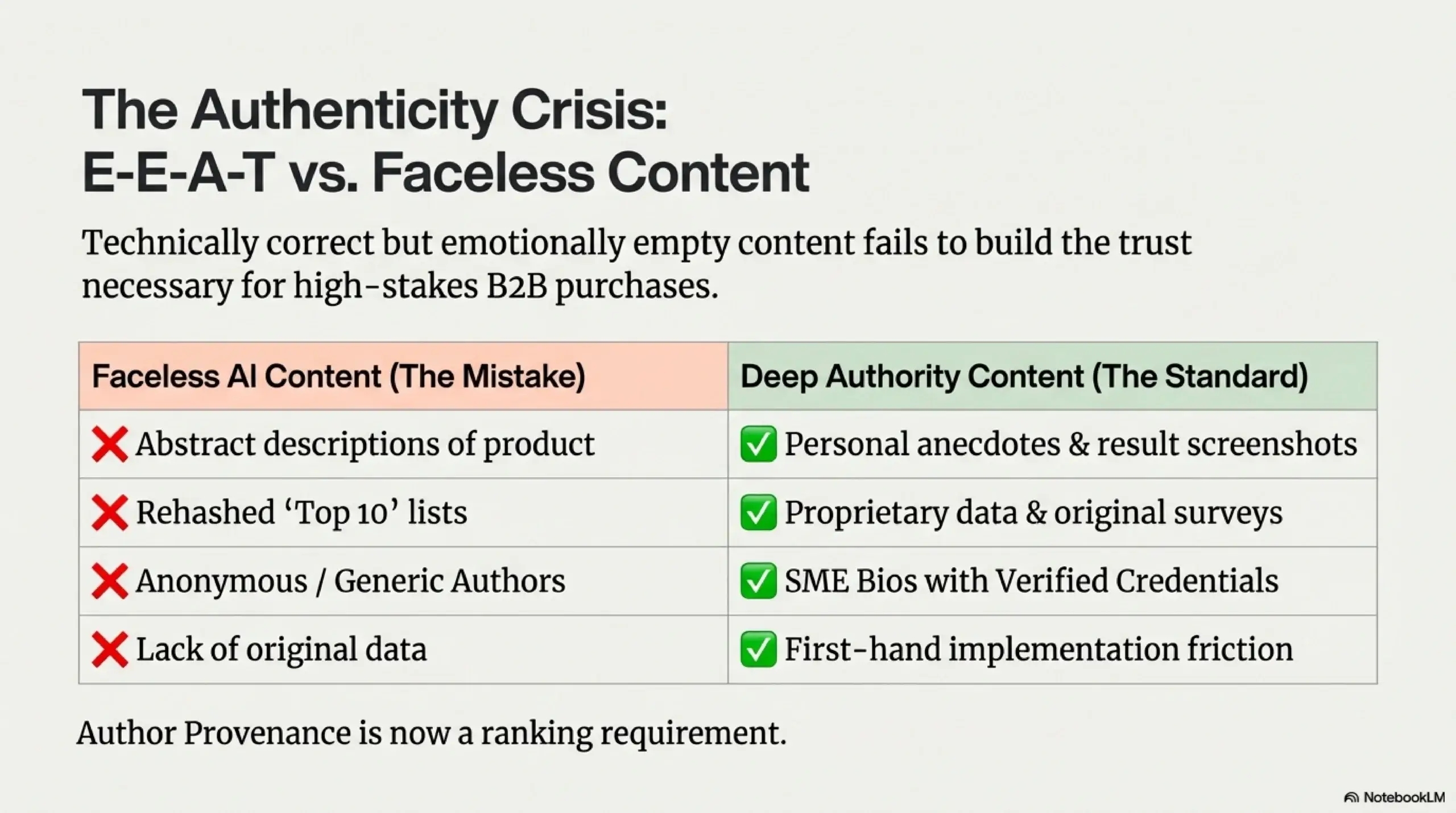
The search engine’s focus on “Experience” means that content that includes real usage details, implementation friction, and documented trade-offs consistently outperforms generic educational material. Content that is “technically correct but emotionally empty” fails to build the trust necessary for a high-stakes B2B purchase.
The Author Provenance Requirement
Another critical oversight is the failure to showcase the credentials of the individuals creating the content. In technical niches, author authority is no longer optional; it is a ranking requirement. Many companies publish articles under a generic brand name, missing the opportunity to leverage subject matter experts (SMEs).
To satisfy E-E-A-T signals, B2B firms must feature recognized experts with detailed bios that highlight certifications, education, and practical experience. Furthermore, the lack of transparency regarding AI use and the absence of original research are significant red flags for both search engines and skeptical technical buyers.
| E-E-A-T Factor | Mistake: Surface-Level Content | Success: Deep Authority Content |
| Experience | Abstract descriptions of product | Personal anecdotes and result screenshots |
| Expertise | Rehashed “Top 10” lists | Proprietary data and original survey findings |
| Authoritativeness | Anonymous/Generic authors | SME bios with verified credentials |
| Trustworthiness | Hidden pricing and vague data | Clear sourcing and transparent limitation |
The Attribution Gap: Connecting Search to Revenue Operations
A fundamental failure in B2B technical SEO is the continued isolation of search strategy from the broader Revenue Operations (RevOps) goals. Many organizations track isolated metrics like keyword rankings and impressions while remaining unable to prove the ROI of their organic efforts.
The Broken Lead-to-Revenue Path
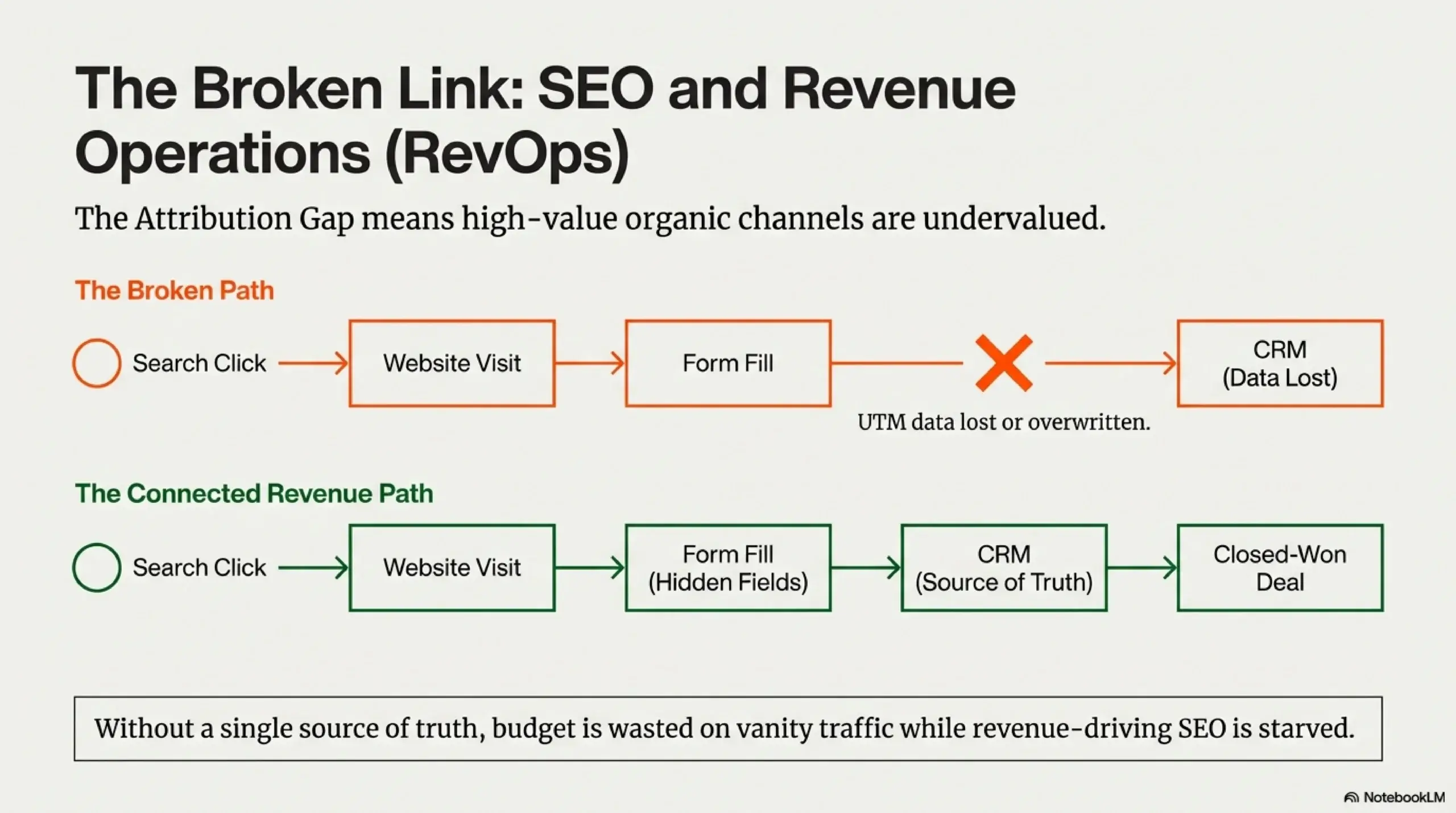
Marketing attribution in B2B is notoriously difficult due to long sales cycles and multiple touchpoints. However, a major mistake is allowing attribution to break before a lead even enters the CRM. This occurs when lead sources and UTM data are not preserved across form fills or when first-touch sources are overwritten by subsequent direct visits.
Without a “single source of truth” that connects organic search discovery to closed-won revenue, budget decisions are made on instinct rather than data. This often leads to high-performing organic channels being undervalued while resources are wasted on vanity traffic that never converts.
The Sales and Marketing Alignment Crisis
There is often a significant disconnect between what marketing produces for SEO and what the sales team needs to close deals. SEO strategies frequently overemphasize TOFU traffic, neglecting the middle-of-funnel (MOFU) and bottom-of-funnel (BOFU) content that influences pipeline velocity.
When marketing and sales are not aligned on the buyer’s journey, the results are inconsistent messaging and fragmented data. For example, a searcher looking for “how to improve VoIP call quality” needs educational tips, while someone searching for “best VoIP provider for healthcare” is ready to compare options and view a demo. Failing to provide content that bridges these gaps is a primary reason why many B2B SEO strategies fail to drive predictable growth.
Product-Led SEO and the Neglect of Technical Conversion Hubs
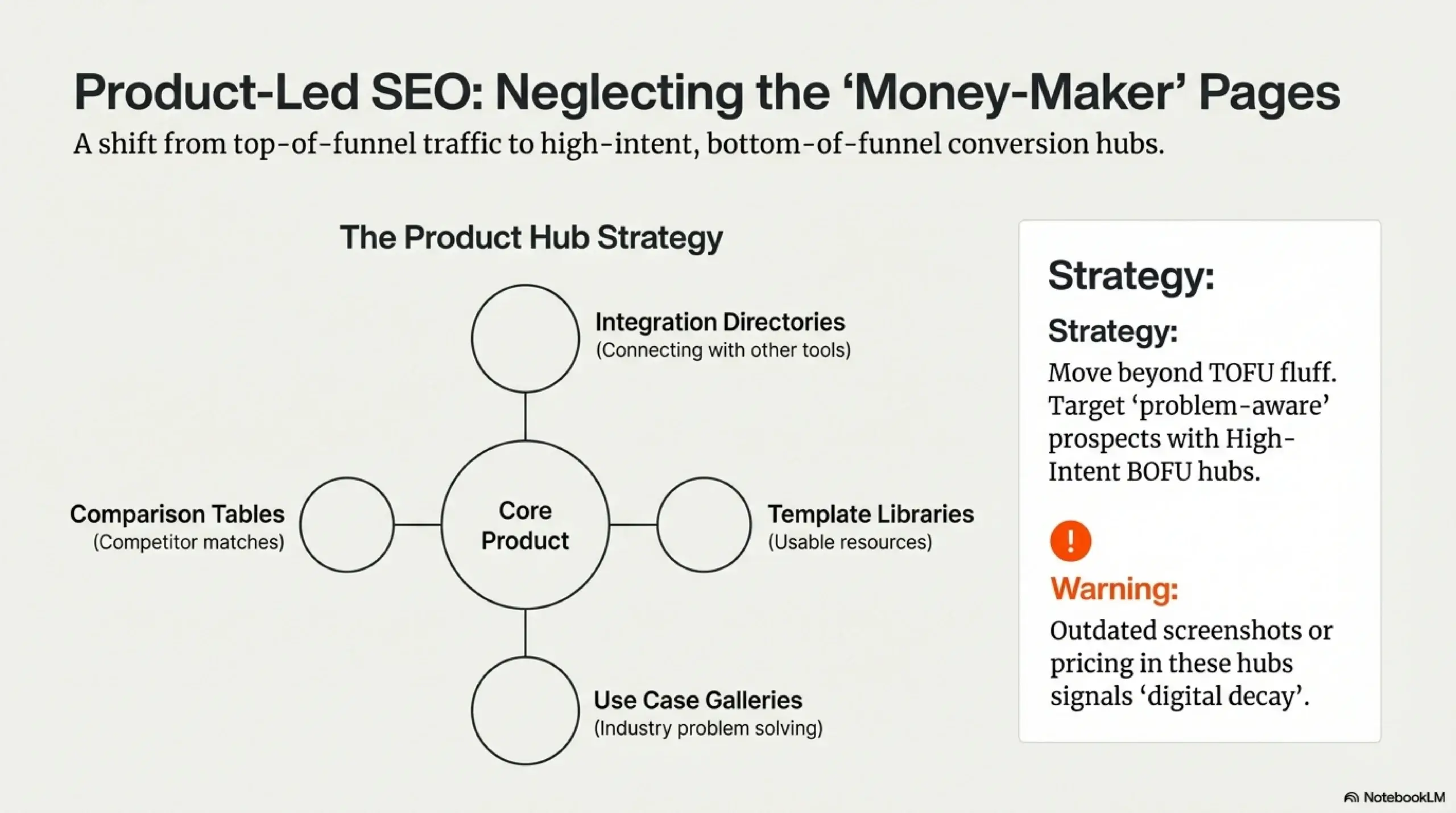
In technical B2B and SaaS markets, the product itself is often the most significant driver of discovery and conversion. A major mistake is treating SEO as a standalone blog-focused activity rather than integrating it into the product experience, a strategy known as Product-Led SEO.
The Oversight of Transactional Hubs
Many technical firms neglect the creation of high-intent “money-maker” pages, such as:
- Integration Directories: Showing how the tool connects with other popular software.
- Template Libraries: Providing actual usable resources for practitioners.
- Use Case Galleries: Demonstrating how different industries solve specific problems with the product.
- Feature Comparison Tables: Honestly matching the product against competitors.
Targeting these keywords allows brands to attract prospects who are already “problem-aware” and “solution-seeking”. Ignoring these opportunities in favor of broad educational topics is a tactical error that leads to a lower conversion rate from visitor to trial or demo.
The Lifecycle Maintenance Failure
SaaS products evolve rapidly, yet their SEO content is often left static. A significant mistake is failing to implement a content maintenance schedule. It is common for product pages to contain outdated screenshots, pricing, or feature descriptions, which provides a poor user experience and signals a lack of technical currency to both search engines and buyers.
Implementing a content lifecycle management system that flags pages for review whenever a product feature changes is essential for maintaining trust and ranking authority.
International SEO and the Complexity Trap
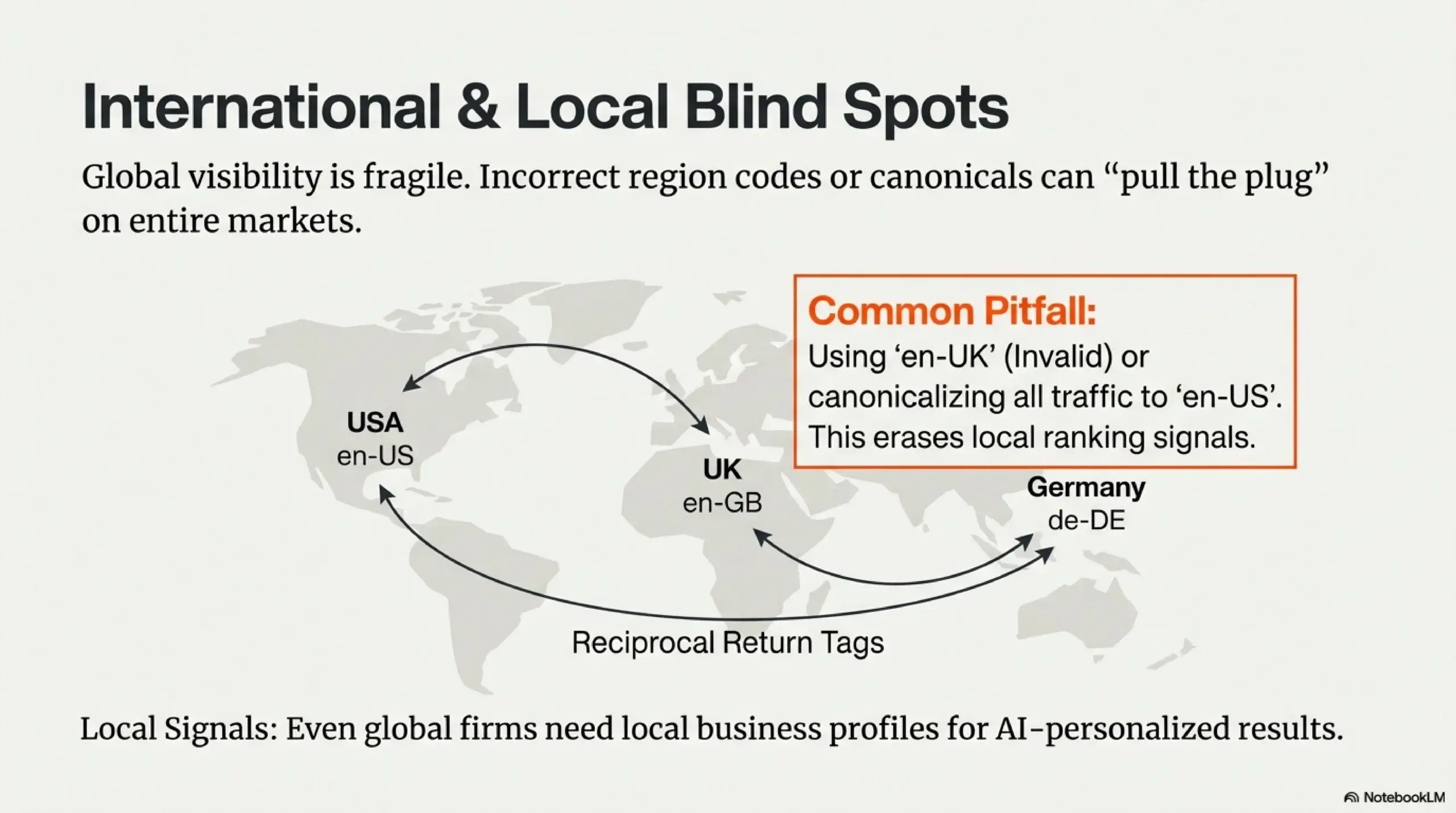
For B2B technical companies operating on a global scale, international SEO presents a unique set of technical challenges that are frequently mishandled. The most common mistakes involve the incorrect implementation of hreflang tags and regional canonicalization.
Hreflang and Return-Tag Errors
Errors in hreflang implementation, such as mismatched canonicals or the omission of self-referencing return tags, prevent search engines from correctly identifying which version of a page to show in different geographic regions. For instance, a common mistake is using incorrect language or region codes (e.g., en-UK instead of en-GB) or canonicalizing all regional variants to a single global URL, which effectively “pulls the plug” on international visibility.
| Hreflang Element | Common Error | Correct Implementation |
| Language/Region Code | en-US (misused for UK) | en-GB (for UK market) |
| Return Tags | Missing backlink from variant | Reciprocal links between all variants |
| Canonical Alignment | Points to different language | Points to self (same regional URL) |
| Scaling | Manual template entry | CMS-driven “single source of truth” |
The Global-Local Disconnect
Even global technical firms often have a physical presence in multiple markets, yet they fail to optimize for local SEO signals. AI search assistants increasingly personalize results based on location and behavior, making local SEO more important for B2B than ever before. Neglecting to claim and optimize local business profiles or failing to generate reviews on region-specific directories can weaken the overall authority of a global entity in localized search results.
The Mismanagement of External Signals and Authority
Link building in B2B technical niches has shifted from a volume-based game to a trust-based game. A significant mistake is continuing to pursue low-quality or irrelevant backlinks rather than focusing on “earned media” and digital PR.
The Quality vs. Quantity Dilemma
In technical markets, a single backlink from an industry publication, a respected trade association, or a widely used developer forum carries more weight than dozens of low-quality links from generic directories. Many companies still fall into the trap of “link spamming,” which today triggers penalties rather than rankings.
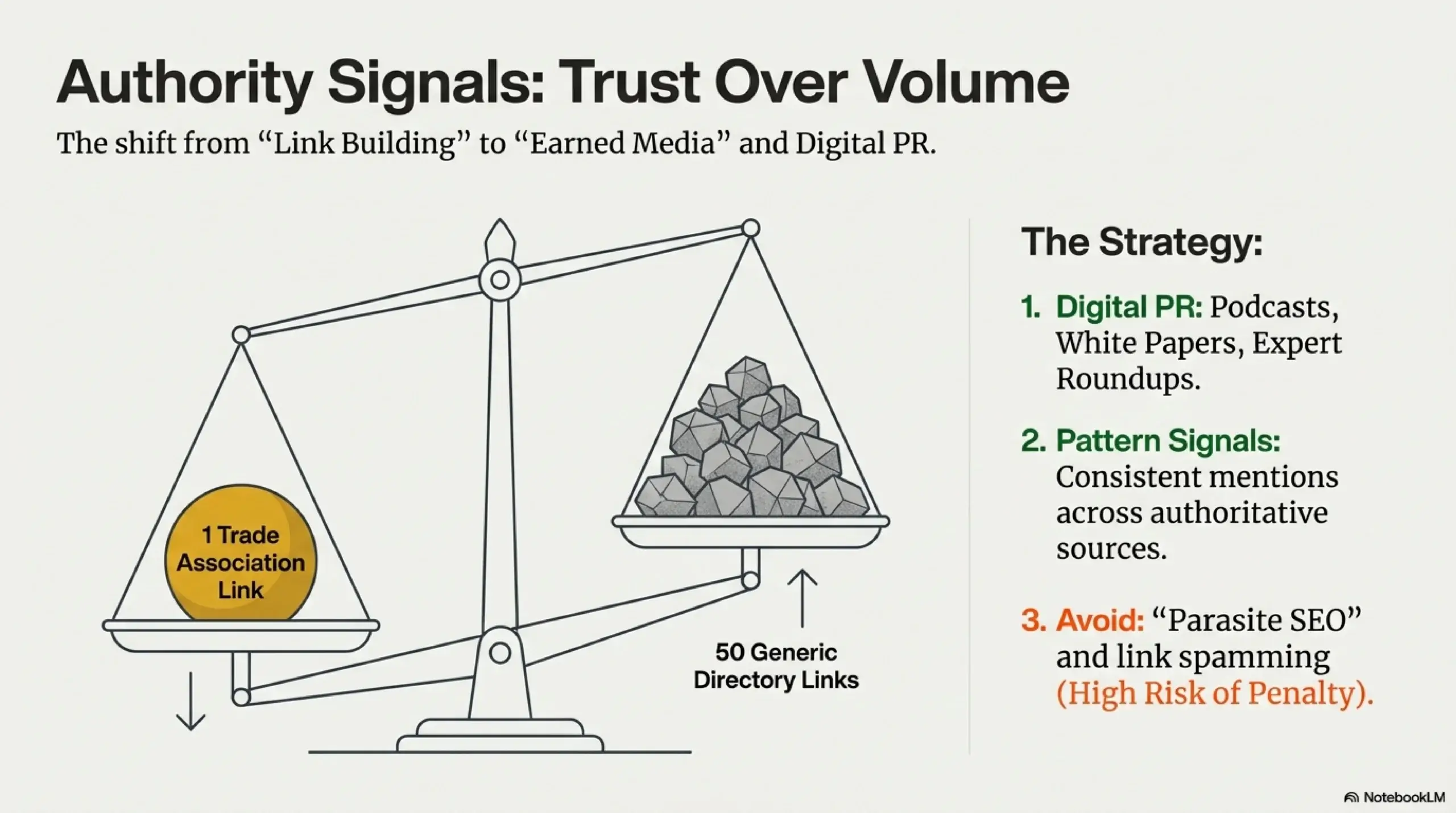
Effective off-page strategy in 2026 must involve credible industry collaborations, such as guesting on technical podcasts, contributing to white papers, and participating in expert roundups. These “pattern signals” from authoritative sources tell both search engines and AI systems that the brand is a trusted entity in its specific category.
The Risk of Parasite SEO and Shortcuts
As competition intensifies, some B2B firms have turned to “risky shortcuts” or “parasite SEO” (leveraging the authority of high-traffic third-party sites through questionable partnerships). These tactics are increasingly detected and neutralized by search algorithms, leading to sudden and often permanent ranking drops. A sustainable strategy prioritizes defensible authority built on original data and genuine expert consensus.
Predictive Analytics and the Proactive Optimization Deficit
| Intent Category | Traditional Metric (Mistake) | Modern Strategic KPI (Correct) |
|---|---|---|
| Informational (TOFU) | Total Sessions / Clicks | Brand Awareness / AI Citations |
| Consideration (MOFU) | Pageviews on Blog | Newsletter Sign-ups / Webinar Reg |
| Transactional (BOFU) | Ranking for “Software” | Demo Requests / Trials / SQLs |
| Revenue Alignment | Organic Traffic Growth | Pipeline Influenced / Closed-Won |
A final, subtle mistake made by many B2B technical companies is being reactive rather than proactive in their SEO efforts. Traditional SEO workflows often struggle to keep up with the pace of algorithmic change.
The Failure to Anticipate Trends
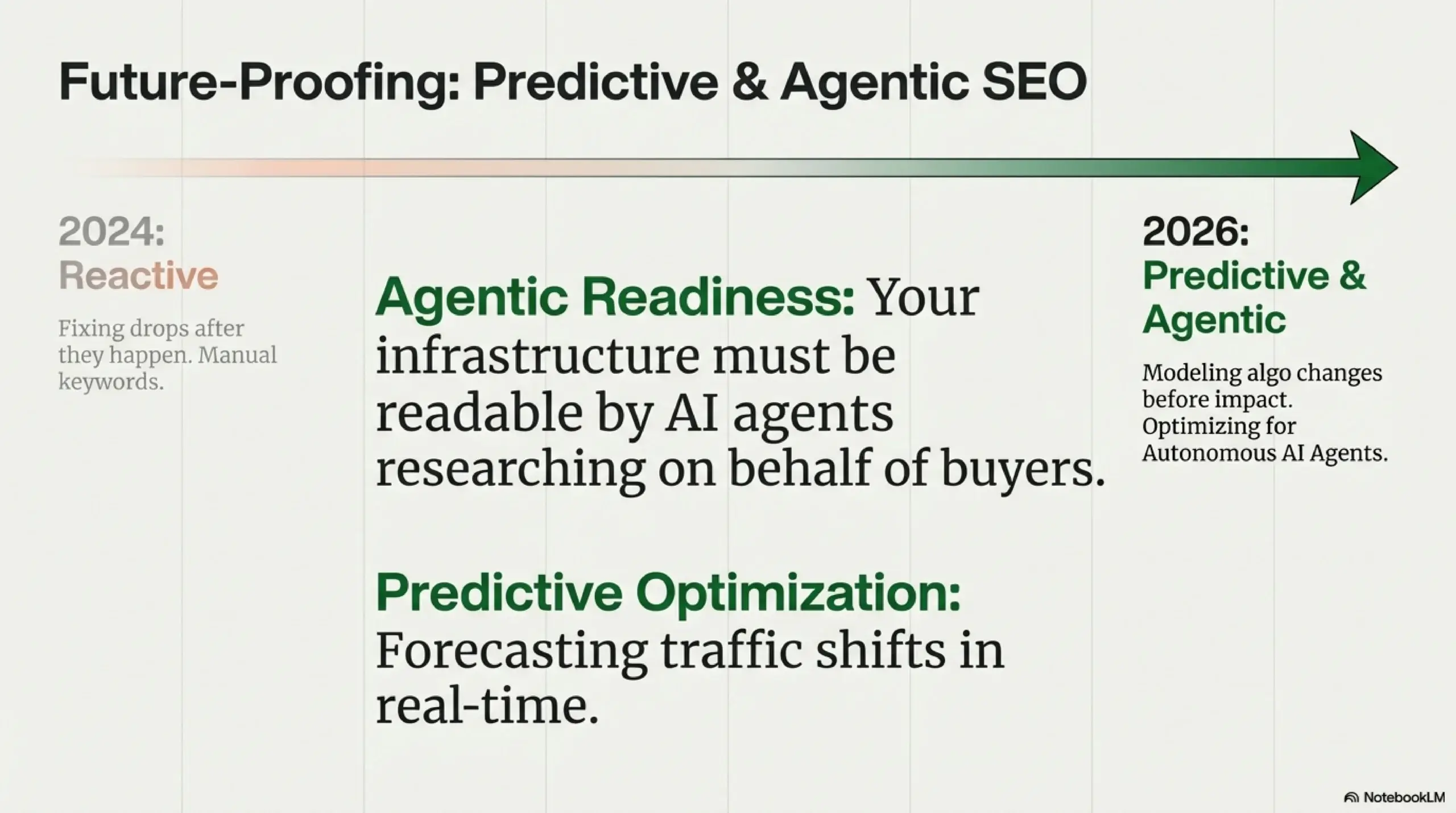
Most organizations only adjust their content strategy after a rankings drop occurs. However, modern AI tools now enable “predictive optimization,” which allows marketers to spot emerging trends, identify content gaps, and forecast traffic shifts in real time. Failing to integrate these predictive insights means that technical teams are perpetually “playing catch-up” while their more agile competitors capture emerging demand.
The Lack of Agentic Readiness
Visibility in 2026 will increasingly depend on “agentic readiness,” the degree to which a brand’s digital infrastructure is optimized for autonomous AI agents that perform research on behalf of buyers.26 This requires a move away from manual keyword lists toward intelligent SEO ecosystems that analyze the SERP in real time and model algorithmic changes before they impact the bottom line.
Synthesis and Strategic Conclusion
The aggregate of these mistakes intends misalignment, technical debt, E-E-A-T erosion, and attribution failures paints a picture of an industry at a crossroads. For B2B technical companies, the primary mistake is the failure to recognize that search is no longer a tactical marketing channel but a core component of the business’s revenue infrastructure.
To thrive in the era of AI-mediated discovery, organizations must execute a radical shift in their operational priorities. This involves:
- Resolving technical performance debt by prioritizing modern signals like INP and ensuring crawlability in complex JavaScript environments.
- Establishing deep subject-matter authority through SME-led content that prioritizes firsthand experience and proprietary data over automated scaling.
- Architecting content for AI comprehension through rigorous structural formatting and the implementation of advanced Schema markup.
- Unifying search strategy with RevOps to ensure a seamless lead-to-revenue path and a consistent brand narrative across all digital touchpoints.
The companies that successfully navigate these transitions will not only survive the disruption of generative search but will also build a resilient, defensible engine for long-term growth. Those that continue to cling to the informational volume models of the past will find their visibility and their pipelines steadily eroding in a marketplace that no longer rewards mediocrity or surface-level engagement.
The era of the “faceless” technical blog is over; the era of the authoritative, technically flawless revenue engine has begun.
Frequently Asked Questions
How can I optimize for autonomous AI research agents?
Optimizing for autonomous AI research agents requires a shift toward agentic readiness, which is the degree to which your digital infrastructure is prepared for AI agents performing research on behalf of human buyers. Your website must function as a technically flawless revenue engine that these agents can easily navigate and interpret.
How is AI changing search from links to answer engines?
AI is fundamentally transforming search by shifting from a model based on blue links to an answer engine era, where platforms like Google use Search Generative Experience (SGE) and AI Overviews (AIO) to satisfy informational queries directly on the search results page.
How can I implement AEO to reduce the citation gap?
To implement Answer Engine Optimization (AEO) and effectively bridge the citation gap, move away from dense, unstructured content and toward a framework that AI systems can easily parse, interpret, and credit. The citation gap represents a lost opportunity where a brand’s insights are used by AI but not attributed, missing the chance to build trust and authority as a featured source.
How do I measure the revenue impact of AI citations?
To accurately measure this impact, focus on the following strategic steps: shift KPIs from traffic to influence, bridge the attribution gap, analyze intent-aligned discovery, and monitor agentic readiness and conversion hubs.

Content Strategist at Topuser.Pro and DeepCopywriting. I craft expert-level copy for E-commerce, corporate websites, and SEO-driven platforms. From deep-dive articles to conversion-focused product descriptions, I deliver content that ranks in Google and resonates with global audiences. Expert in the nuances of the 2026 digital landscape.
