

AI-Powered Article Review:


The transition to SEO in 2026 requires a fundamental shift from task management to system architecture. This article examines why the manual approach is ineffective and how business owners can optimize their budgets through advanced technical solutions.
The obsolescence of human speed in search
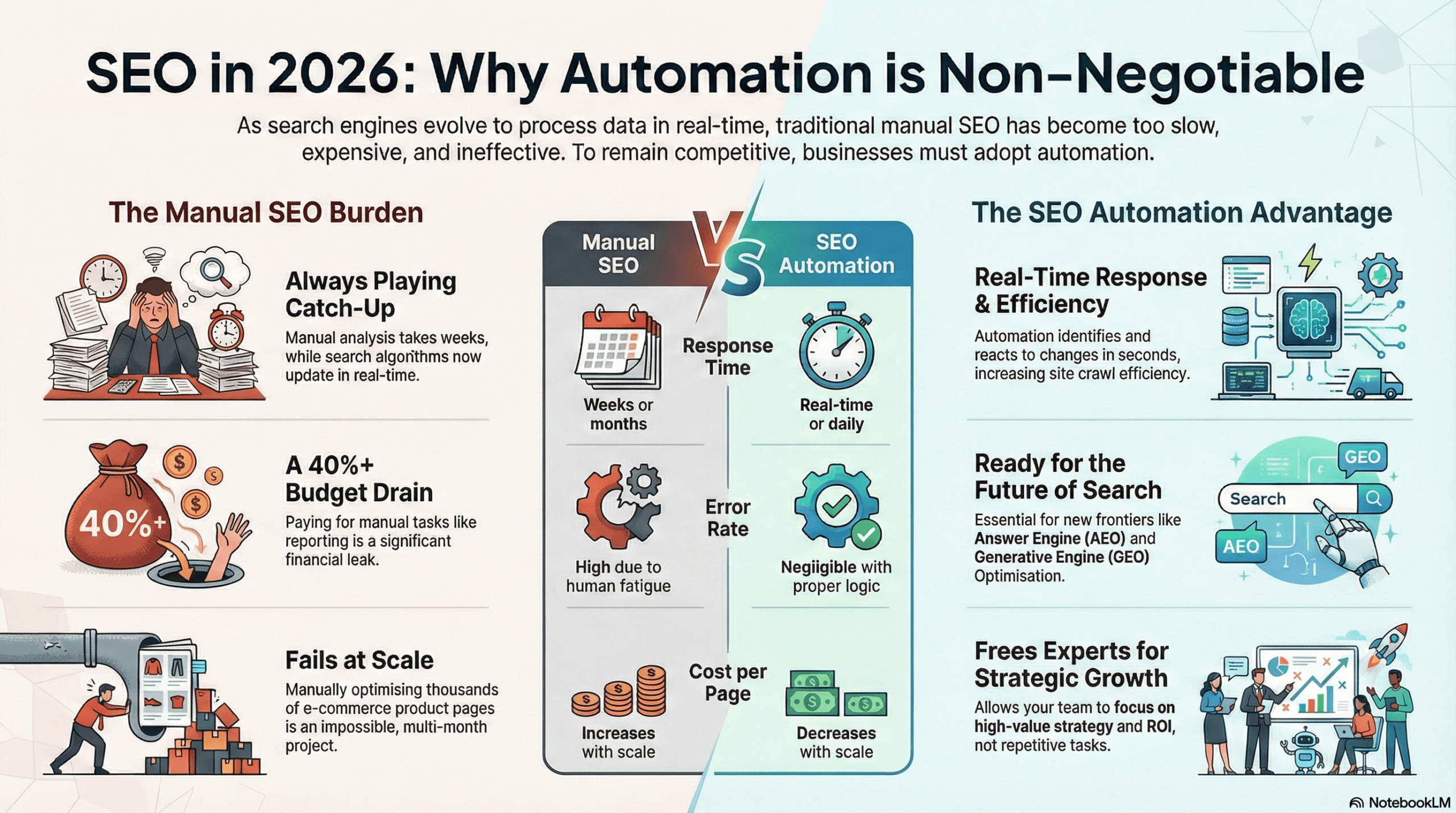
The primary reason manual efforts fail today is the sheer volume of data that modern search engines process. Algorithms now update in real time based on user intent and live data feeds. A human specialist requires days to analyze a traffic drop, whereas SEO Automation systems identify and react to these shifts within seconds.
The high cost of technical debt
Manual technical audits often take weeks to complete and even longer to implement through development queues. By the time a manual fix is live, the search environment has likely changed again. This creates a cycle of permanent technical debt where your site is always three steps behind the competition.
Scalability limitations for e-commerce
For a store with fifty thousand products, manually optimizing every header and schema markup is a multi-month project. Automated workflows can deploy dynamic structured data across an entire catalog instantly. The difference in deployment speed directly translates to captured market share during peak shopping seasons.
AEO and GEO: The new frontiers of visibility

The search landscape has branched into two critical areas that manual processes cannot handle effectively: Answer Engine Optimization and Generative Engine Optimization.
Navigating Answer Engine Optimization
AEO focuses on providing direct answers to user queries within AI assistants and smart devices. These engines prioritize structured data and clear, authoritative facts over traditional keyword density. Creating these structures at scale requires programmatic content blocks that manual writers simply cannot produce fast enough.
The rise of Generative Engine Optimization
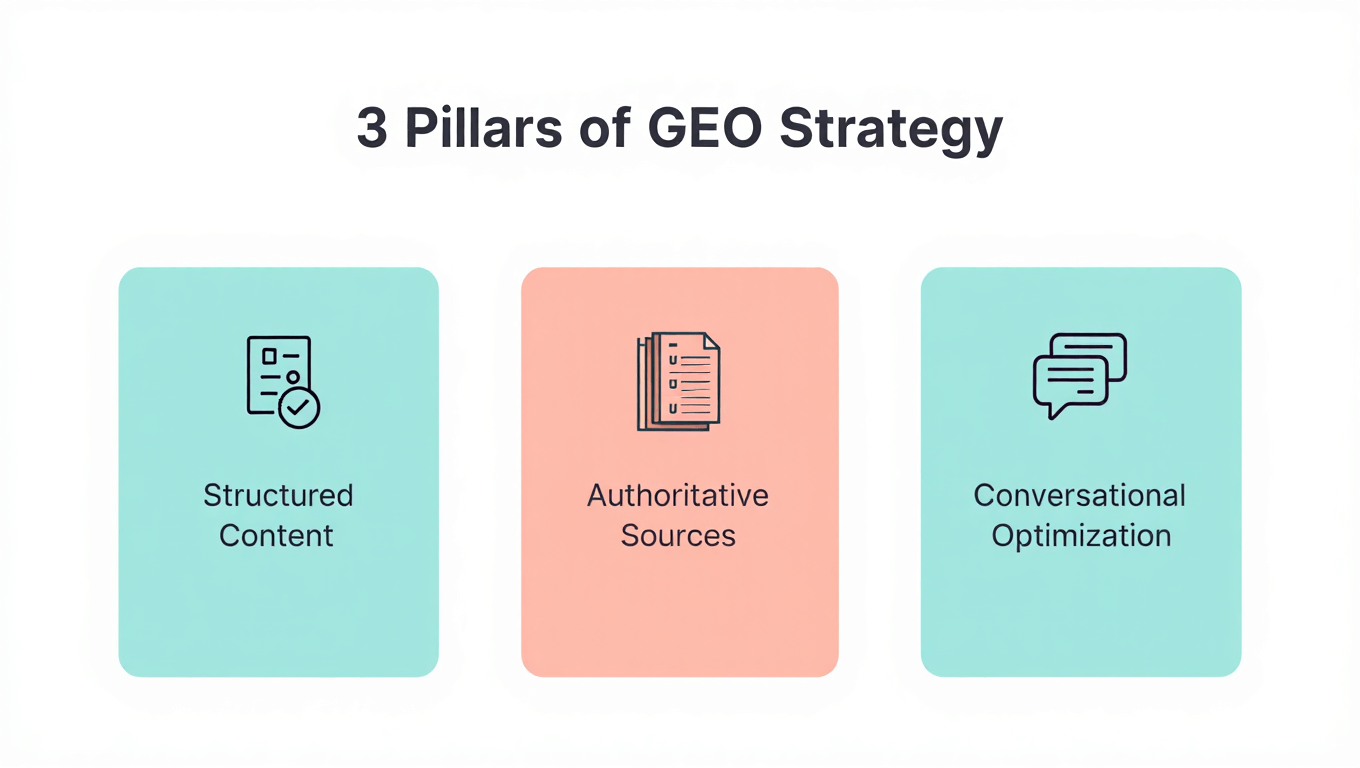
GEO is the practice of optimizing content to be cited by large language models during generative search sessions.4 Since these models refresh their knowledge bases frequently, your content must be technically perfect and semantically rich. Automation ensures your brand remains a primary source for these models by maintaining a high frequency of data refreshes.
Manual vs. Automated: A performance comparison
| Category | Manual SEO | SEO Automation |
|---|---|---|
| Response Time | Weeks or months | Real-time or daily |
| Error Rate | High due to human fatigue | Negligible with proper logic |
| Cost per Page | Increases with scale | Decreases with scale |
| Focus | Executing repetitive tasks | Strategic growth and ROI |
Strategic resource allocation
To survive as a business owner in this environment, you must stop paying for labor and start investing in logic. Your experts should spend their time interpreting high-level data and refining brand voice, not clicking through spreadsheets.
Pro tip for budget recovery
Audit your current marketing spend to see how many hours are billed for basic tasks like keyword research or reporting. If these tasks are not automated, you are likely overpaying by at least forty percent. Redirect those funds into building custom SEO Automation scripts that handle these functions permanently.
Real-world implementation
Consider a mid-sized retailer that automated its internal linking and image alt text. They reduced their agency fees by half while seeing a twenty percent increase in crawl efficiency. The system now runs in the background, allowing the marketing manager to focus on high-conversion landing pages and partnership deals.
Future-proofing your digital assets

The goal for SEO in 2026 is to create a self-sustaining ecosystem. Your website should be a dynamic entity that adjusts its own metadata and internal structure based on live performance metrics.
Immediate Action Steps:
- Implement automated rank tracking with AI-powered volatility alerts.
- Use programmatic SEO to generate landing pages for long tail queries.
- Integrate AEO focused schema on all high-value product pages.
The window for manual intervention is closing. Business owners who continue to fund labor-intensive SEO strategies will find their budgets depleted with little to show for the investment.
If you are ready to stop the financial leak and modernize your operations, consider investing in a comprehensive set of SEO Automation workflows. You can also book a consultation to review your current systems or purchase the latest guide on 2026 search strategies to ensure your business remains visible in the age of AI.
FAQ. Why Automation is Key for Success.
1
12
How does the transition from manual labor to system architecture impact search visibility?
The transition from manual labor to system architecture is a fundamental shift required for SEO in 2026, as the sheer volume of data processed by modern search engines has made human speed obsolete. This shift impacts search visibility by moving away from slow, task-based management toward automated systems that can react to real-time algorithmic updates and shifts in user intent within seconds.
Why is automation essential for navigating the emergence of generative and answer engines?
Automation is essential for navigating the emergence of Answer Engine Optimisation (AEO) and Generative Engine Optimisation (GEO) because the speed, scale, and technical precision required by these systems have made manual processes obsolete.
What strategic shifts are required to eliminate technical debt and optimize marketing budgets?
To eliminate technical debt and optimise marketing budgets in the current search landscape, businesses must undergo a fundamental transition from task-based management to system architecture.
How does SEO automation improve response times compared to manual efforts?
SEO automation significantly improves response times by shifting from human-speed analysis to real-time execution, which is essential as search engine algorithms now update in response to live data feeds and user intent. While a human specialist may require days to analyse a traffic drop, automated systems can identify and react to these shifts within seconds.
How does automation facilitate scalability for large e-commerce catalogs?
Automation facilitates scalability for large e-commerce catalogues by replacing time-consuming, repetitive manual tasks with logic-based systems that can handle vast amounts of data instantaneously. For a store with fifty thousand products, manual optimisation of every header and schema markup is a multi-month project. However, automated workflows can deploy dynamic structured data across an entire catalogue instantly.

Content Strategist at Topuser.Pro and DeepCopywriting. I craft expert-level copy for E-commerce, corporate websites, and SEO-driven platforms. From deep-dive articles to conversion-focused product descriptions, I deliver content that ranks in Google and resonates with global audiences. Expert in the nuances of the 2026 digital landscape.
